User Research and Prototyping
User Research and Prototyping
Design Thinking Project
In this project, I analyzed the usability, workflows, and user experience of Jira with the goal of identifying improvement opportunities from a user-centered and product-oriented perspective. The project followed a structured Design Thinking process, covering research, synthesis, problem framing, ideation, prototyping, and validation.
The first phase focused on product and context research. I examined Jira’s core features, workflows, and typical usage scenarios in software development and project management environments. Based on this analysis, I defined key user groups, including developers, product managers, and project coordinators, and identified typical tasks, expectations, and usage patterns.
To better understand real user behavior and pain points, I conducted user interviews and documented observations systematically. The collected insights were analyzed using methods such as affinity mapping and empathy mapping, allowing recurring patterns and key challenges to emerge.
The research highlighted several recurring issues, particularly in:
navigation and information structure
complexity of configuration and permissions
task clarity and workflow transparency
uncertainty about data accuracy and task status
Based on these findings, I formulated problem statements and “How Might We” questions to guide solution development. The ideation phase focused on generating practical improvements that could realistically enhance daily workflows rather than redesigning the entire system.
Selected concepts were translated into low-fidelity prototypes, designed to visualize potential improvements in structure, usability, and workflow clarity. These prototypes were tested in usability sessions, where participants interacted with the concepts and provided structured feedback. The results were evaluated and used to refine the proposed solutions.
The project concluded with a set of actionable recommendations aimed at improving usability, reducing cognitive load, and supporting clearer task management and collaboration in Jira-based environments.
Through this project, I strengthened my skills in:
user research and qualitative analysis
synthesis and problem framing
prototyping and usability testing
translating user insights into practical product improvements
This work reinforced the importance of understanding real user behavior before proposing solutions and demonstrated how structured research and iterative design can significantly improve complex enterprise tools.
Jira Prototype
Prototype Strengths
The prototype introduced several usability improvements that had a clear impact on workflow clarity and efficiency.
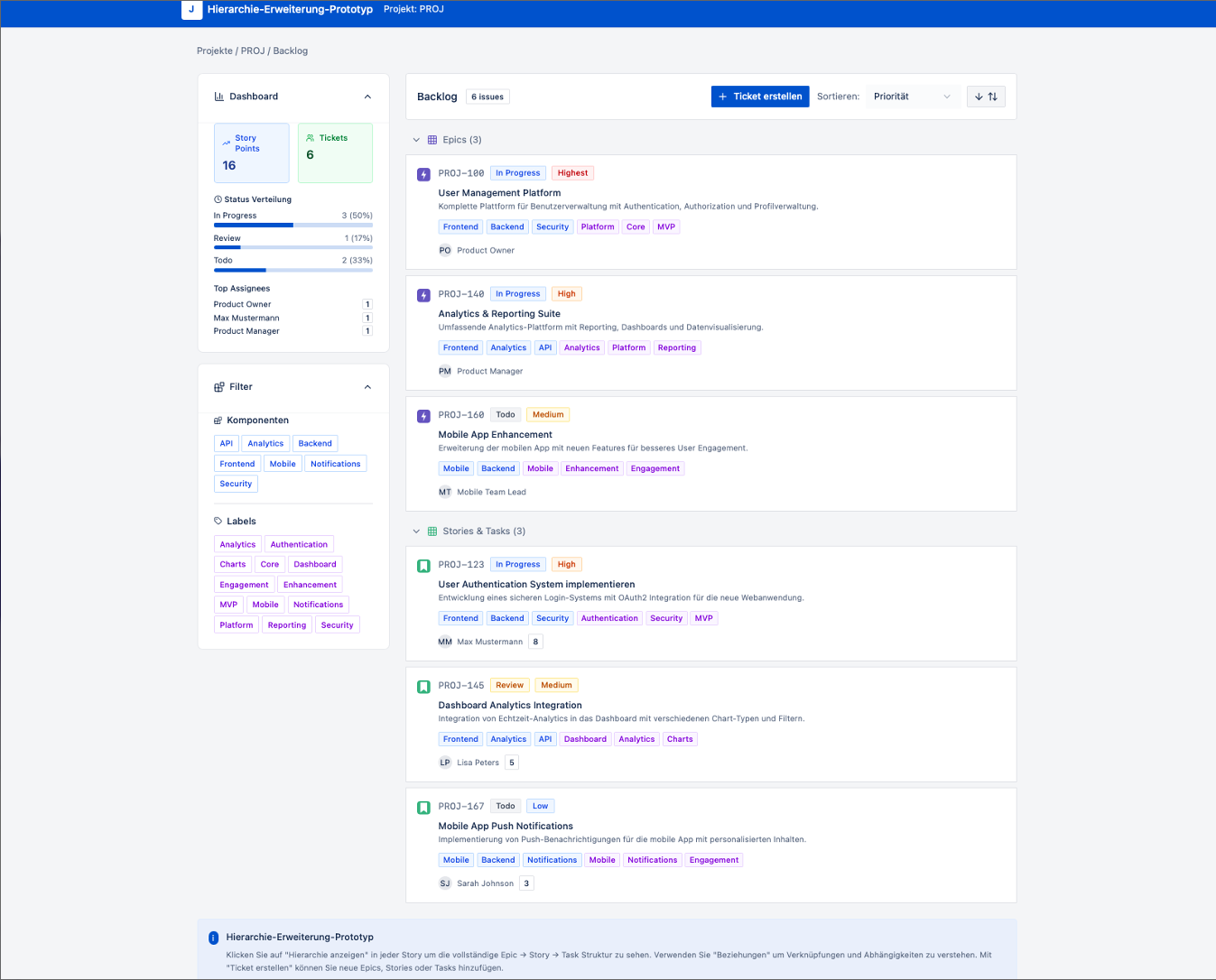
The hierarchical visualization was immediately understandable and perceived as a significant simplification of complex structures. The relationship dialog made dependencies between items more transparent than in the current Jira interface, helping users understand connections and impacts more quickly.
The filtering by components and tags was considered highly useful, as it allowed users to switch context with a single interaction instead of navigating through multiple steps. The most impactful feature was the ability to create tickets directly within the hierarchy, which significantly reduced manual effort and accelerated daily workflows.
Usability Test – Key Findings
The usability tests showed a clear and consistent perception of value across participants.
The most significant benefit identified was the reduction of clicks and navigation effort, making common tasks faster and more intuitive. Direct ticket creation within the hierarchy proved to be particularly effective, enabling users to structure work more naturally and saving measurable time per task.
Another important insight was the improved overview and transparency, especially when managing dependencies or complex project structures. Users were able to understand relationships and priorities more quickly, which supported planning, refinement, and coordination activities.
Conclusion
The tests demonstrated a clear return on efficiency: fewer steps, less searching, and greater transparency. The prototype confirmed that improving structure and visibility can significantly enhance usability and productivity in complex project environments.
