

JTBD Analysis and Prototyping
Optimizing Jira Workflows through User Research, JTBD Analysis and Prototyping
User Research, Usability Testing, Low-Fidelity Prototyping
In this project, I analyzed how teams work with Jira in real project environments, with the objective of improving workflow clarity, status transparency, and collaboration efficiency. The work combined Jobs-to-Be-Done (JTBD) interviews with usability testing and low-fidelity prototyping to translate real user needs into practical solution concepts.
The research showed that many daily challenges were not caused by missing functionality, but by uncertainty about task status, fragmented handovers, and repetitive structural work. Users spent significant time verifying information, reconstructing context, or manually recreating recurring task structures. This increased cognitive load, slowed down decision-making, and reduced confidence in project data.
To structure insights, I applied the Jobs-to-Be-Done framework to understand the underlying motivations behind user behavior. The analysis revealed that users are not simply managing tickets. They are trying to create clarity, maintain trust in information, and enable others to continue work independently without unnecessary follow-up.
Based on these findings, I designed and evaluated several low-fidelity solution concepts focused on reducing friction and improving transparency.
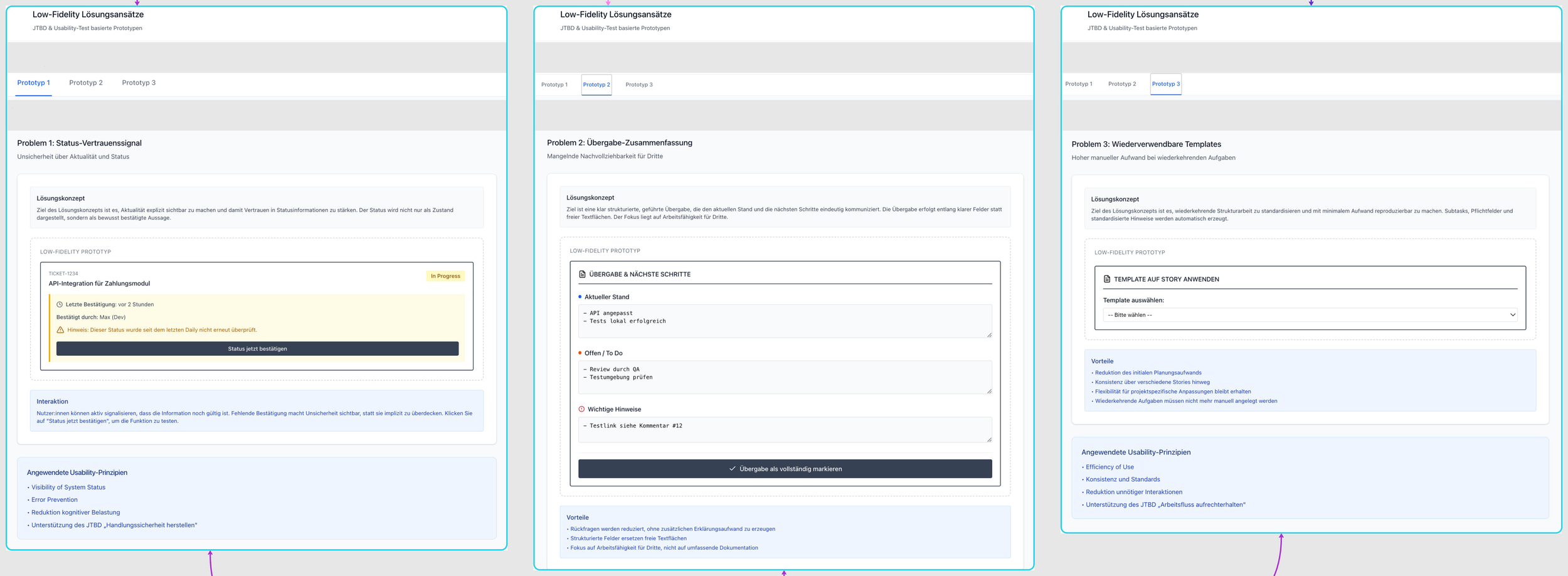
One prototype introduced a status confidence signal, making the freshness and reliability of information explicitly visible. Instead of interpreting status indirectly, users could confirm and communicate validity directly, increasing trust in status information and reducing repeated checks.
Another concept focused on structured handover summaries. By replacing free text with guided fields, the prototype improved handover quality, reduced follow-up questions, and made tasks easier to understand for other team members. The emphasis shifted from documentation for its own sake to ensuring work continuity.
A third prototype introduced reusable workflow templates for recurring tasks. Standardized structures, automatically generated subtasks, and predefined fields reduced manual planning effort and improved consistency across tasks and stories while maintaining flexibility for project-specific adjustments.
The combination of JTBD analysis and usability testing proved particularly valuable. JTBD helped uncover the underlying motivations and needs, while usability testing revealed real behavior and concrete friction points. Together, these methods provided a complete picture of both the why and the what behind user problems, enabling targeted solution design.
This work demonstrated that improving enterprise tools often depends less on adding new features and more on improving clarity, structure, and visibility. When users trust information and maintain orientation, collaboration becomes faster and decision-making more confident.
Prototypes
Analysis
Improved status transparency and reduction of repeated manual checks through explicit status confirmation
Reduction of handover-related clarification effort through structured summaries and guided documentation
Reduction of planning effort through reusable templates and standardized structures
Improved orientation and decision confidence through clearer information hierarchy and visibility
Estimated efficiency gain of up to 20–30 percent in task preparation and handover scenarios, based on usability testing observations and measured interaction steps
Reduction of navigation and verification steps by up to 40 percent in typical workflows
Noticeable reduction of uncertainty and increased trust in task status, improving collaboration quality and workflow continuity
